
Blount County Release Date Types
A projected date is not a completed release record. It is calculated from a judgment, sentence length, offender range, offense and offense date, jail credit, concurrent or consecutive terms, and the credit rules that apply. A court or corrections agency may change the calculation when a judgment is amended, credit is corrected, or another sentence is found. A date can also identify eligibility rather than the day a door will open.
Actual release is the custody event recorded by the facility. For the Blount County Adult Detention Facility, the BCSO booking/release sheet is the best document for the county exit time, type, and destination. For TDOC, FOIL and correctional records supply the state status. A transfer ends one agency's custody but does not put the person in the community.
| Date or status | What it means | Best confirmation |
|---|---|---|
| Release eligibility | The point at which parole consideration or another statutory release mechanism may become available. | Judgment, statute, and TDOC calculation |
| Projected physical release | An estimate based on the present record, credits, decisions, and holds. | FOIL label plus TDOC or BCSO |
| Sentence expiration | The end of the imposed sentence calculation; it may differ from a parole date. | TDOC sentence record |
| Discharge | The end of the applicable state sentence or supervision according to the agency record. | FOIL and discharge documentation |
| Actual release | The facility's recorded custody exit, including its type or destination. | Booking/release sheet or state release record |
Find Blount County Release Dates
Choose the route from the sentence and custodian, not from the county name alone. InmateNOW is a present-inmate roster. It does not advertise a historical release-date search. FOIL applies to Tennessee felony custody or supervision, not every local arrest. A county court record may explain the legal basis for release but may not record the minute BCSO completed the physical exit.
- Identify whether the person is pretrial, serving a local sentence, in TDOC custody, or held for a federal or immigration matter.
- For a county case, check BCSO InmateNOW and the Blount public court docket. Read bond, judgment, jail-credit, and hold information.
- For a Tennessee felony sentence, open the TDOC FOIL page and search by TOMIS number when possible.
- Copy the exact status, location, and date labels. Do not rename parole eligibility or expiration as an actual release date.
- Contact BCSO Records at 865-273-5003 for a county release sheet, or TDOC for the official state calculation when the public display is unclear.
The Blount County released inmate lookup covers the full after-release trail when the person is already gone. It pairs the court event with the BCSO exit and follows any transfer into TDOC, BOP, or ICE custody.
The official TDOC Offender Search page provides the FOIL launch and the MyTN option.
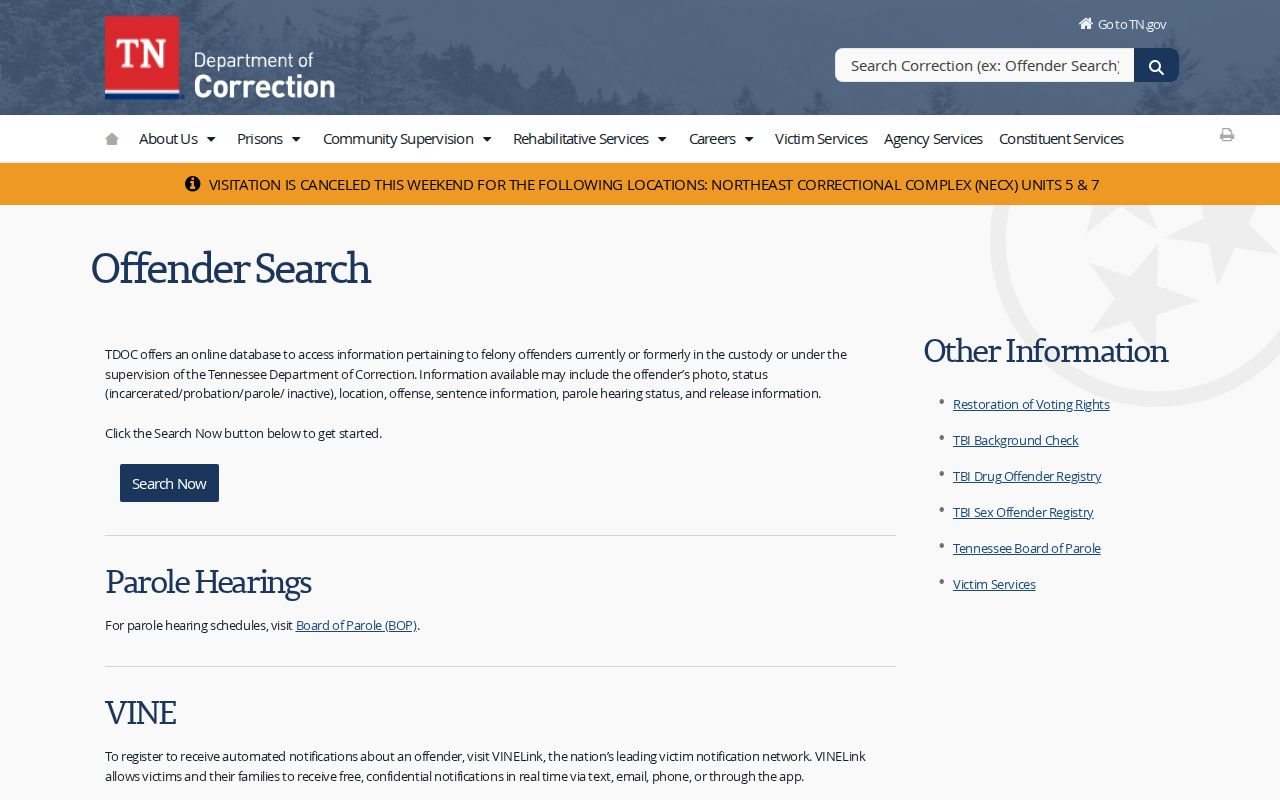
This official gateway distinguishes a state correctional search from the BCSO county jail roster.
Blount County FOIL Date Labels
FOIL means Felony Offender Information Lookup. Search by TOMIS number when available because it is more exact than a name. Otherwise compare the surname, given and middle names, birth information, photograph, and conviction data. The detail can include correctional status, institutional or supervision location, and sentence or release-related dates. The precise live wording must be retained.
A parole or community-supervision location means the person can be outside prison while still active in the Tennessee correctional system. A discharged or expired status is different. “Inactive” generally points away from current TDOC custody or supervision, but it does not establish why or when a particular county booking ended. A person missing from FOIL may have a local non-felony matter, a spelling mismatch, a processing lag, a federal case, or an expunged charge.
The FOIL search form shows the public fields used to narrow a Tennessee offender search.
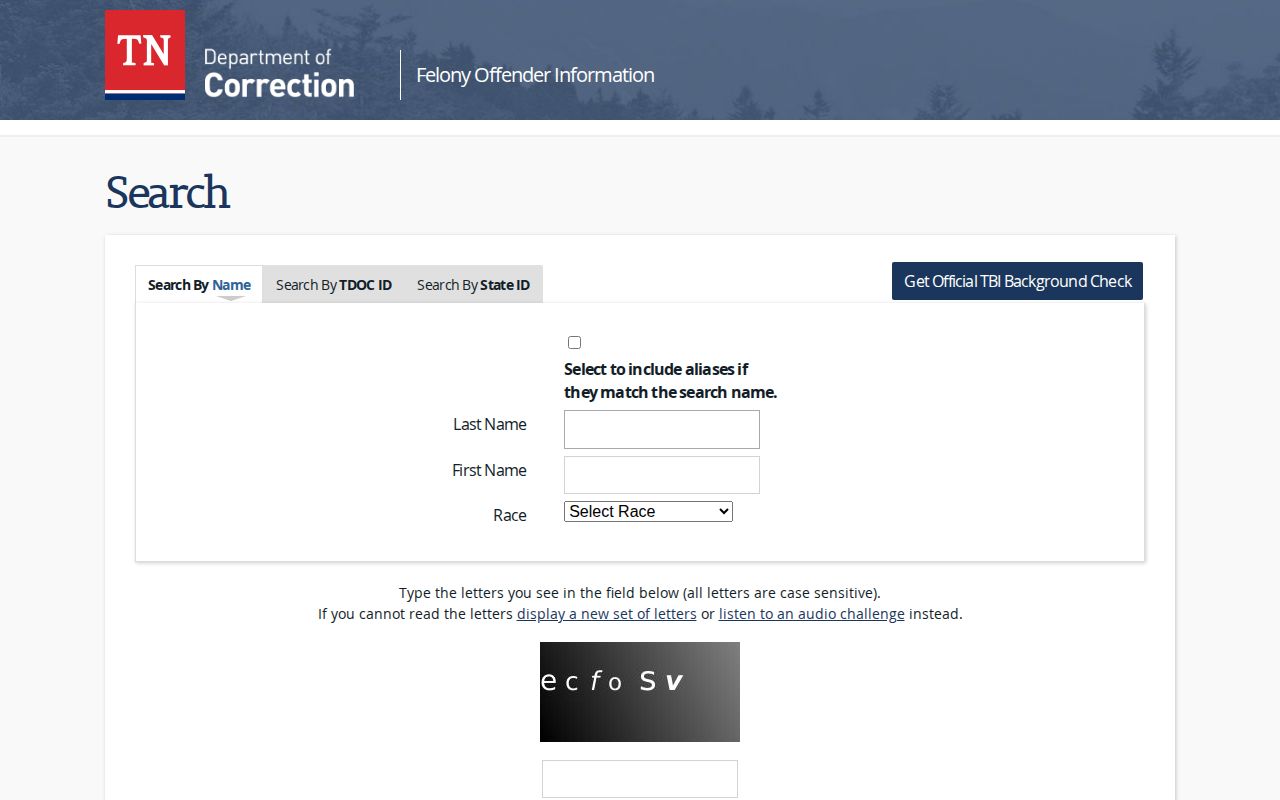
The form is most useful when a TOMIS number can separate people who share a name.
Note: Record the search date because correctional status and projected milestones can change after the result is saved.
Blount County Sentence Credits
Tennessee sentence reduction credits are governed by T.C.A. § 41-21-236. Eligible TDOC inmates may receive documented monthly credits for good institutional behavior and satisfactory program work. The statutory limits run from one to sixteen days a month, with up to eight behavior days and eight program days. Awards are discretionary. A disciplinary board may review or remove them.
A partial month and a month with a Class A disciplinary infraction do not receive the ordinary award. Behavior credit is barred for a month with disciplinary guilt. Maximum-security and punitive-segregation conditions can also limit credits. Separate possible 60-day credits exist for an approved educational credential and a qualifying intensive residential substance-use program, but offense-based exclusions apply.
The statute also addresses locally housed felony offenders, presentence jail credit, and misdemeanor local sentences. Local good time cannot simply override a court-fixed release percentage. For a person serving at the Blount County Adult Detention Facility, ask the jail for its calculation and compare it with the judgment. A generic calculator cannot account for the offense date, exclusions, consecutive terms, or each agency's official credit record.
Blount County Parole Eligibility
T.C.A. § 40-35-501 supplies the central release-eligibility framework. The judgment's offender range matters. Examples in the statute include 20 or 30 percent for especially mitigated offenders as stated on the judgment, 30 percent for Range I, 35 percent for Range II, 45 percent for Range III, and 60 percent for career offenders, subject to the terms and credit rules in the statute.
Tennessee does not have one rule that every prisoner serves 85 percent. The familiar figure applies only to specified offenses and date ranges. Other listed offenses require 100 percent service or sharply restrict how credits affect eligibility. Felony sentences over two years are generally the class eligible for parole consideration. Shorter sentences have a special suspension-at-eligibility structure, subject to notice and consecutive-sentence rules.
Eligibility means the Tennessee Board of Parole may consider release. It does not require a grant. A Board grant may still be followed by release-plan review, conditions, another detainer, or rescission. The date that matters must be identified as eligibility, a projected physical exit, or sentence expiration.
Why Blount Release Dates Change
Several parts of the legal and custody record can move a date. Some alter the sentence calculation. Others leave the sentence date intact but stop physical release. The source of the change should be named rather than treating every later date as lost good time.
| Change | Possible effect | Where to verify |
|---|---|---|
| Corrected jail credit | Changes credited time already served. | Judgment, jail, and TDOC computation |
| Discipline | Can prevent, remove, or later restore eligible credits. | Correctional credit record |
| Program completion | May add a qualifying credit when the statute permits. | TDOC record and statute |
| Amended or appealed judgment | Can revise sentence terms or effective dates. | Blount court docket |
| Consecutive case | Adds ineligibility periods rather than allowing terms to overlap. | All judgments and TDOC calculation |
| Parole decision | A grant, denial, deferral, appeal, or rescission can alter the expected path. | Board record and FOIL |
| Detainer or new warrant | May block community release even when one sentence reaches a milestone. | Holding and receiving agencies |
A court order can authorize release while another hold remains. BCSO may then transfer the person rather than release them to the community. The county release sheet should identify that destination if recorded. For a state prisoner, TDOC and the receiving agency must reconcile any handoff.
Blount Release Dates After 2024
Tennessee law changed the interaction between sentence credits and parole eligibility for some felony terms greater than two years based on offenses committed on or after July 1, 2024. In that setting, current law may let credits shorten the percentage of service required before parole eligibility without changing the sentence expiration date. Two different dates can therefore be correct because they answer different legal questions.
Older offenses and shorter terms can operate under other versions or parts of the statutes. The offense date must be checked before applying a percentage or credit rule. This is why the judgment, FOIL label, and official calculation belong together. A later expiration date does not cancel an earlier eligibility date, and an eligibility date does not prove that parole will be granted.
Note: Apply the statute in effect for the offense and let the official custodian calculate the person's sentence.
Confirm Blount County Release Dates
A pretrial county detainee has no fixed sentence date. Check the bond order, court setting, and other holds, then ask Adult Corrections about present custody. A locally sentenced person requires the BCSO calculation and judgment. A state prisoner requires the exact FOIL date label and TDOC confirmation. Federal and immigration custody use their own systems.
A pending event can also be monitored with a Blount County VINE inmate check. Register on the correct person and agency record, then confirm any alert with BCSO or TDOC. VINE notification supports the inquiry but does not replace the actual release document.
Preserve the date and source of each check. If the court, FOIL, and facility give different dates, ask which one is an eligibility milestone, which is sentence expiration, and whether a hold blocks physical release. Do not average the dates or choose the earliest one. The discrepancy often reflects distinct legal events rather than a simple data error. Once release occurs, request the agency record that identifies the actual exit and its destination.
- Detainer
- A request or legal hold from another authority that may prevent community release.
- Concurrent
- Sentences served at the same time, as authorized by the judgments.
- Consecutive
- Sentences served one after another, which can extend the overall calculation.
- Expiration
- The end of the sentence term, distinct from an earlier parole-eligibility date.
Public Record Search
Sponsored Results