
Blount County Supervision Types
Tennessee assigns parole, probation, and discharge distinct meanings. The Tennessee Board of Parole decides whether an eligible state prisoner may leave prison on parole. TDOC Field Services then supervises state parole and state probation. A Blount County court can order probation without a state prison stay, or after a period of confinement. The judgment may also place a person in a local misdemeanor probation program or Recovery Court. Those routes cannot be merged into one status.
Parole is conditional release before a state sentence expires. A Board grant begins a process that can still require an approved plan, conditions, and a check for other holds. Probation is a sentence imposed by the court. It may replace confinement, follow split confinement, or use a determinate-release form for a qualifying short felony term. Discharge means the relevant supervision or sentence has ended. It should be confirmed from the exact TDOC or court record rather than inferred from how long the person has been out.
| Status | Who Orders It | Best Blount County Check |
|---|---|---|
| Parole | Tennessee Board of Parole | TDOC FOIL status and office, then Board or Field Services confirmation |
| State probation | Sentencing court, supervised by TDOC | FOIL and the listed TDOC field office |
| Local probation | Blount County court | Court judgment and the local office named in the case |
| Discharge | Follows completion under the controlling sentence or order | FOIL date/status plus the judgment or discharge record |
- Parole
- Conditional community release from a state sentence before its expiration.
- Probation
- Court-ordered community supervision that may occur with or without confinement.
- Discharge
- The end of the sentence or supervision identified by the official record.
- TOMIS number
- The TDOC identifier used to distinguish people with similar names.
Verify Blount County Supervision
Begin with the sentence source. A person who left the Blount County Adult Detention Facility after a misdemeanor case may have only a local court record. Someone transferred into Tennessee felony correctional custody may remain searchable in TDOC's Felony Offender Information Lookup, known as FOIL. A state record may show an institution, community supervision, a supervising location, release-related dates, or an inactive status. Copy the labels exactly. “Not in prison” does not mean “discharged from TDOC.”
Use a TOMIS number when it is known. It is more precise than a name. If only a name is available, compare middle name, birth details, photo, and conviction data before relying on the match. The Blount County court docket supplies the judgment and later violation events. When FOIL and the judgment point to different offices, contact the office shown by the most current official status and ask for public routing confirmation.
- Identify whether the sentence is a Blount County matter or a Tennessee felony supervision case. Save the full name, date of birth, case number, and TOMIS number when available.
- Search TDOC FOIL. Open the matching record and record the status, location or supervising office, and every date label verbatim.
- Review the Blount public court record for the judgment, probation order, revocation entry, or other event that names the legal basis.
- Contact the listed TDOC field office for state supervision. Use the Blount County probation contact only if the judgment routes the person locally.
- If parole is at issue, compare FOIL with Board hearing information. A scheduled hearing or nonbinding recommendation is not a release or final grant.
Blount County TDOC Field Office
TDOC's Field Office Directory places Blount County in District 21. The Blount/Loudon office is the precise local contact when FOIL identifies TDOC community supervision. Staff can limit what they disclose, so ask whether the office is the correct public contact and how to route a status or records question. Do not ask for private case details.
TDOC Blount/Loudon Field Office
304 Home Avenue
Maryville, TN 37801
865-981-2360
State probation and parole routing after a FOIL match
Blount County Programs
Probation: 865-273-5990
Recovery Court: 865-273-5581
Use only when the court judgment names the local program
A state field office and a county program are not substitutes. The sentence and current status decide which office applies. TDOC also says a person placed on probation must report within the period directed by the governing release and supervision rules, so the order and release instructions should control rather than a general assumption.
Note: Confirm the office from FOIL or the judgment before sending names, dates of birth, or case identifiers to any contact.
Blount County Parole Hearings
The Tennessee Board of Parole, not BCSO or the county probation line, makes state parole decisions. Its Hearings Division explains that hearing officers conduct proceedings in TDOC institutions, local jails, and other sites. Their recommendations are nonbinding and go to Board members for review. Board schedules cover state prisons and county jails and are normally refreshed each Monday, or Tuesday after a Monday holiday.
The schedule may help confirm that a hearing is planned. It cannot prove a grant or a physical release date. Outcomes can include grant, denial, deferral, revocation-related action, rescission, time setting, or appeal work. Even a grant can be followed by release planning, conditions, a detainer, or rescission. Compare the final Board status with FOIL and the actual custody record.
The official source illustrates how Tennessee separates the hearing process from the supervision record: see the Board's parole-hearing explanation.
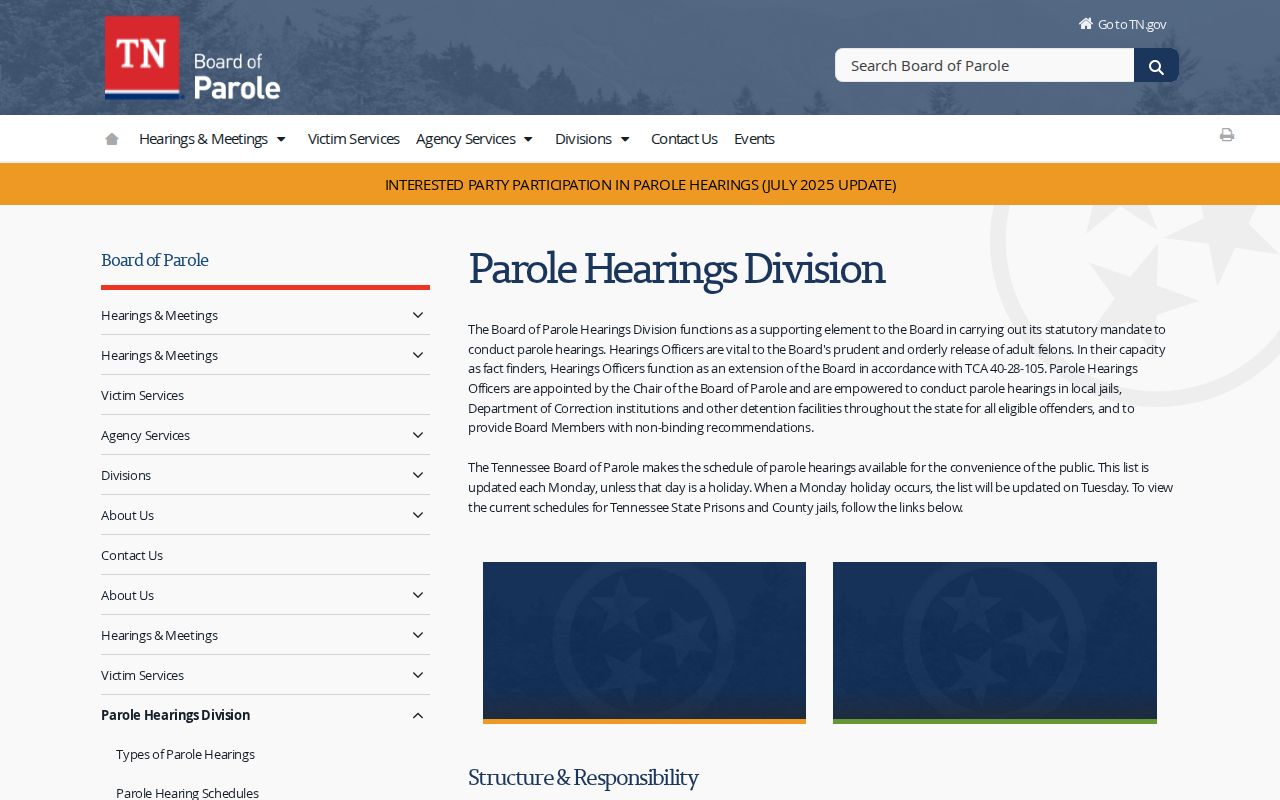
The schedule and explanation establish the process, while FOIL and agency confirmation establish the person's current post-release supervision status.
Blount County Supervision Violations
Conditions vary by judgment, Board order, and supervision type. They can govern reporting, travel, treatment, fees, contact, and compliance with law. The signed order is the source for one person. A general list cannot establish what applies in a Blount County case, and a violation allegation does not itself prove a new offense.
An absconder notation means the supervising agency alleges that the person stopped reporting or cannot be located. A parole violation warrant can lead to arrest and a revocation process before the Board. A probation violation normally returns to the sentencing court. Check the current agency warrant or status record, then the Board or court event. Old third-party entries should not be treated as current proof.
Revocation and rescission also differ. Revocation addresses alleged noncompliance after supervision begins. A pre-parole rescission issue can arise before the planned release is completed. Either event can change a projected path. The Board appeal process has limited grounds and a written deadline, so an appeal should not be described as an automatic rehearing.
Note: An absconder or violation label is an agency allegation and status marker, not proof of a new conviction.
Blount County Supervision Routing
Blount County has more than one supervision route. County Probation and Recovery Court appear in the county directory, while TDOC Field Services handles state probation and parole. A court may also order community corrections or another named program. The judgment and FOIL status must be read before choosing a phone line. The phrase “probation in Blount County” is too broad to identify the custodian.
When an online result is missing, start with the court that entered the judgment. The court record may show the probation term, later violation, or discharge event. For a state case, use the TOMIS number with TDOC. For Board material that is no longer on a hearing schedule, the Board public-records process accepts a focused request that identifies the offender and TDOC number. The Board describes email as its fastest request route and follows the state's response framework.
A release record and a supervision record answer separate questions. BCSO documents when county custody ended and whether the exit was a transfer. The court or TDOC record shows what legal control followed. For the custody-exit search and release sheet, use the Blount County released-inmate search path.
Blount County Release Record Routing
Sheriff booking and release records do not go through the same path as general county archives. Blount County directs BCSO requests to GovTransfer or BCSO Records at 865-273-5003. Older county-government material may be routed through Records Management and Archives, which asks onsite researchers to arrange a visit. This split matters when a person needs a release sheet, a corrected booking record, or proof of the custody exit that preceded supervision.
Ask BCSO for an existing booking/release sheet or custody-history entry tied to a named booking. Ask TDOC for a state supervision or discharge record tied to a TOMIS number. Ask the court for its judgment and later orders. Keeping those requests separate reduces misrouting and avoids sending sensitive identifiers to an office that does not hold the record.
Online silence has several possible causes. A person may have a non-felony county case, a misspelled name, an old case outside the portal's main public window, a lawful expungement, or a federal matter. FOIL is not a list of every Blount County release, and the live jail roster is not a supervision database.
Property After Blount County Release
Post-release records can intersect with a practical local deadline. BCSO's personal-property policy states that property not picked up within 30 days after release is treated as abandoned and destroyed. Published pickup windows are Tuesday or Saturday from 11:00 a.m. to 1:00 p.m. or 7:00 p.m. to 9:00 p.m. The recipient needs valid photo identification, and written authorization and receipt rules apply.
This property process is not supervision. It does, however, create a narrow post-release document trail. Tennessee's sheriff retention schedule treats a receipt for property returned on release as a permanent record category. That receipt can corroborate a transaction, but the BCSO release sheet remains the main proof of release date, time, and type.
When someone moves from the jail to parole or probation, handle the tasks through the right offices. BCSO handles stored property and the county custody record. TDOC or the court handles supervision. A family member should not assume the field office can release jail property or that a property receipt proves the sentence has ended.
Note: The 30-day property deadline is separate from the retention period for booking, release, court, or supervision records.
Public Record Search
Sponsored Results